
What to Expect During Your First MRI Scan
Being told you need an MRI produces two reactions at once: concern about why it was ordered, and uncertainty about what the scan involves. The second is entirely fixable with information. An MRI is painless, uses no radiation, and the main challenges are the noise and staying still — most people find it far less difficult than they anticipated. Rather than X-rays, it uses a strong magnetic field and radio waves to produce detailed images of soft tissue, which is why it is the standard investigation for a torn knee ligament, a slipped disc, a suspected stroke, or a detailed look at the liver or uterus. The 1.5 Tesla figure refers to magnetic field strength, and a higher field produces clearer images in less scanning time.
Preparation begins with safety screening. You will be asked in detail about metal in your body, because the magnet is always on and extremely powerful. Tell the radiology team about any pacemaker or implanted cardiac device, cochlear implants, aneurysm clips, metal fragments in the eye, joint replacements, plates, screws, spinal rods, insulin pumps, past surgeries, or any possibility of pregnancy. Many modern implants are MRI-safe and many are not, so never assume — bring your implant card if you have one. Most scans allow normal eating and drinking, though some abdominal studies require fasting. Wear clothing without zips, hooks or underwire, and leave jewellery, watches, hearing aids, hairpins, your phone and cards at home or in a locker.
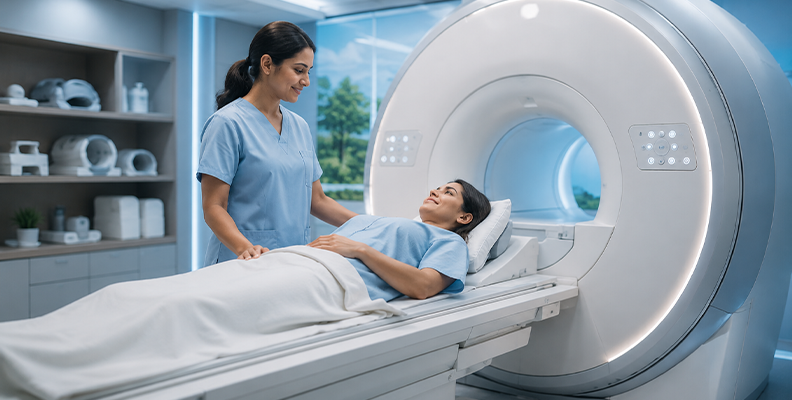
During the scan you lie on a padded table that slides into a wide cylindrical opening, sometimes with your head remaining entirely outside depending on the area being imaged. The noise is the part nobody warns people about enough — knocking, thumping and buzzing sounds that change as sequences run. It is completely normal, and you will be given earplugs or headphones, often with music. Your only real job is staying still, since movement blurs images. The technologist watches you continuously, speaks through an intercom, tells you how long each sequence lasts, and gives you a call button. Most scans finish in 20 to 45 minutes. If you are claustrophobic, say so when booking rather than on the day: keeping your eyes closed from before you enter, using music, bringing a companion, or arranging a mild sedative in advance all help considerably.
Some scans require a gadolinium-based contrast injection through a cannula to highlight blood vessels or inflammation — reactions are uncommon and usually mild, but mention any kidney disease, dialysis, pregnancy, breastfeeding or previous contrast reaction beforehand. Afterwards you resume normal activity immediately with no aftereffects and no restrictions, unless you were sedated. A radiologist reviews the images and reports typically within a day or two, going to your referring doctor who will interpret them alongside your symptoms and examination. Resist reading the raw report in isolation, as many findings — particularly incidental spine changes — are common, age-related and unrelated to your symptoms. Unity Hospital, Kunnamkulam operates a 1.5 Tesla MRI unit with trained radiology staff and on-site reporting.