
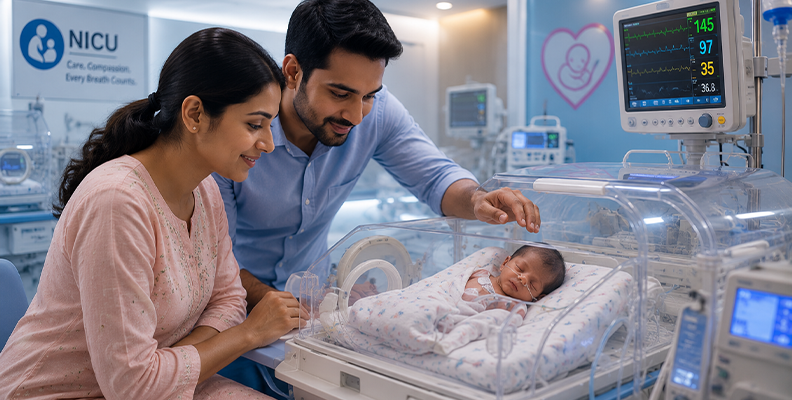
Newborn Care Essentials: A Parent's Guide to NICU Support
Few moments are more disorienting than being told your newborn needs to go to the NICU. The room you had imagined — baby in your arms, quiet, ordinary — is replaced by monitors, tubes and unfamiliar terms delivered quickly by people moving with purpose. A Neonatal Intensive Care Unit is a specialised space for newborns needing closer monitoring than a normal postnatal ward provides, staffed by neonatologists and nurses trained specifically in newborn care. The important framing is that admission is not automatically a crisis: many babies come in for observation, feeding support or jaundice treatment and go home within days, entirely well. Others need intensive support over weeks, and the unit handles both.
Babies are admitted for several common reasons. Those born before 37 weeks may need help with breathing, temperature regulation and feeding simply because these systems have not finished developing. Babies under 2.5 kg often struggle to maintain body temperature and blood sugar. Breathing difficulty is among the most frequent reasons and usually resolves quickly with support. Jaundice is very common and, where bilirubin runs high, is treated with phototherapy under blue light — straightforward and effective. Suspected infection is treated promptly with antibiotics because early treatment matters, and low blood sugar, more common in babies of diabetic mothers, is corrected with careful feeding or a glucose drip.
The equipment is often the most frightening part, largely because it goes unexplained. An incubator maintains a warm, humidity-controlled environment, conserving the energy a premature baby would otherwise spend staying warm — energy better used for growing. Monitors display heart rate, breathing and oxygen saturation, and they alarm frequently; most alarms are not emergencies, since a slipped sensor or a moving baby will set them off. Watch the staff rather than the screen, because their reaction tells you what matters. CPAP delivers gentle pressure through small nasal prongs to keep the lungs open while the baby breathes independently, and a ventilator provides breaths directly where a baby cannot manage alone. A feeding tube is necessary because coordinated sucking and swallowing does not develop until around 34 weeks, and it does not hurt.
The most common and most mistaken assumption is that parents become bystanders. Parental involvement measurably improves outcomes. Kangaroo mother care — holding your baby skin-to-skin — is not a comfort gesture but an evidence-based intervention that stabilises heart rate and breathing, improves weight gain, supports breastfeeding and shortens hospital stay. Breast milk is genuinely protective for a premature or sick newborn, substantially reducing the risk of serious gut infection, so express regularly and early and ask nursing staff for help. Talk to your baby, since your voice is already familiar from the womb. Ask questions freely, look after your own eating and sleeping, and expect progress to be uneven — good days and setbacks alternate, and a step backwards rarely changes the overall direction. Unity Hospital, Kunnamkulam operates a 15-bed NICU with neonatology and paediatric care for premature, low birth weight and unwell newborns.